
Taiji: A Door Already Open Onto the Tao
11/08/26 21:23
After the Taoism retreat these past few days, one thought keeps coming back to me. Many of you have been practicing taiji quan for months, sometimes years, without ever opening a book on Taoist philosophy. And yet, on the mat, in the silence of the movement, you're already right in the middle of it.
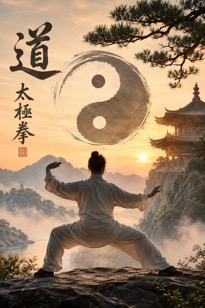 We don't practice in order to become Taoist
This might be the first thing to understand: taiji quan isn't a physical exercise to which we then add, as an option, a layer of Chinese philosophy. It is Taoist philosophy in motion, from the very first step. When you shift your weight from one leg to the other, when you let the movement arise from the dantian rather than forcing it with the shoulders, you're not illustrating an abstract idea, you are that idea, being lived through your body.
Yin and Yang, in the legs before they're in the books
The Taiji symbol, that black and white circle everyone recognizes, isn't a decorative logo. It's literally a description of what you do in every form: fullness and emptiness constantly exchanging places, one leg bearing weight while the other frees itself, one hand advancing while the other withdraws. Yin never truly opposes Yang; it prepares it, nourishes it, becomes it. It's a lesson the body often understands long before the mind does.
Wu Wei is not laziness
One of the most misunderstood concepts in Taoism is Wu Wei, "non-action." It's sometimes imagined as a form of passivity. It's actually the opposite: it's the art of doing exactly what's needed, without excess, without unnecessary resistance, by flowing with the natural movement of things rather than fighting against it. When an experienced practitioner performs a form and it seems to "flow," with no visible effort, that's Wu Wei at work. It's not that they're doing nothing, it's that they're doing nothing extra.
The Tao is not thought, it is walked
Lao Tzu opens the Tao Te Ching by warning that the Tao that can be named is not the true Tao. A line that confuses many readers, and that makes perfect sense the moment we stop trying to understand it and simply practice it instead. Taiji offers exactly this path: there's no need to intellectually grasp the Tao in order to meet it. You just need to practice, again and again, until the body knows what the mind still struggles to put into words.
What this changes, in practice
Nothing, and everything. You can keep practicing exactly as before. But maybe the next time you feel that moment when the movement almost happens by itself, when breath and gesture align without you having to think about it, maybe you'll recognize that moment for what it truly is: a moment of Tao, lived, not just read.
Serge Gillette often says that theory comes to illuminate what the body has already understood. That's exactly it.
This might be the first thing to understand: taiji quan isn't a physical exercise to which we then add, as an option, a layer of Chinese philosophy. It is Taoist philosophy in motion, from the very first step. When you shift your weight from one leg to the other, when you let the movement arise from the dantian rather than forcing it with the shoulders, you're not illustrating an abstract idea, you are that idea, being lived through your body.
Yin and Yang, in the legs before they're in the books
The Taiji symbol, that black and white circle everyone recognizes, isn't a decorative logo. It's literally a description of what you do in every form: fullness and emptiness constantly exchanging places, one leg bearing weight while the other frees itself, one hand advancing while the other withdraws. Yin never truly opposes Yang; it prepares it, nourishes it, becomes it. It's a lesson the body often understands long before the mind does.
Wu Wei is not laziness
One of the most misunderstood concepts in Taoism is Wu Wei, "non-action." It's sometimes imagined as a form of passivity. It's actually the opposite: it's the art of doing exactly what's needed, without excess, without unnecessary resistance, by flowing with the natural movement of things rather than fighting against it. When an experienced practitioner performs a form and it seems to "flow," with no visible effort, that's Wu Wei at work. It's not that they're doing nothing, it's that they're doing nothing extra.
The Tao is not thought, it is walked
Lao Tzu opens the Tao Te Ching by warning that the Tao that can be named is not the true Tao. A line that confuses many readers, and that makes perfect sense the moment we stop trying to understand it and simply practice it instead. Taiji offers exactly this path: there's no need to intellectually grasp the Tao in order to meet it. You just need to practice, again and again, until the body knows what the mind still struggles to put into words.
What this changes, in practice
Nothing, and everything. You can keep practicing exactly as before. But maybe the next time you feel that moment when the movement almost happens by itself, when breath and gesture align without you having to think about it, maybe you'll recognize that moment for what it truly is: a moment of Tao, lived, not just read.
Serge Gillette often says that theory comes to illuminate what the body has already understood. That's exactly it.