
Congee : My Taoist Breakfast
16/04/26 17:30
Congee: My Taoist Breakfast
What is congee?
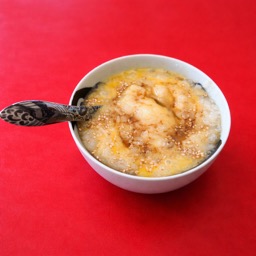 Congee — called zhou (粥) in Chinese — is a porridge made by cooking rice slowly in a large amount of water. The ratio of water to rice varies across cultures and regions, but the idea is always the same: letting the rice break down until it reaches a soft, creamy, almost velvety texture.
It is one of the oldest and most universal foods in Asia. In China, it has been consumed for over 2,000 years, with traces found in writings from the Zhou dynasty (around 1000 BC). In Japan it is called okayu, in Korea juk, in Thailand khao tom, in Vietnam cháo. Across Asia, it holds the same place: a simple, nourishing, comforting meal. The one you make when you are ill, when it is cold outside, when you want to take care of yourself.
In traditional Chinese medicine, congee is considered one of the most beneficial foods for the stomach and spleen. It warms the center, aids digestion, and nourishes without straining the body. It is no coincidence that Zen monks have eaten it for centuries at breakfast.
How I got here
For a long time, I started my mornings with a bowl of granola and goat's milk yogurt — from a local farm I was fond of. I had already taken a first step by switching from crunchy cereal to granola, which is less sweet. But I was still looking for something better: less sugar, more sustained energy, and above all something simple to prepare in the morning when time is short.
It was while exploring Asian food traditions — naturally aligned with my taiji quan and qi gong practice — that congee presented itself as an obvious choice. A warm meal first thing in the morning, easy to digest, neutral in flavour but endlessly adaptable. I tried it. And I never looked back.
My recipe (simple and effective)
I prepare my congee in advance, in the evening or at the start of the week, using a rice cooker.
Preparation:
In the morning:
I serve myself a bowl, reheat it in the microwave, and add:
That's it. Five minutes, no more. And it's delicious.
What I noticed
After a few weeks, the effects are clear:
Congee and the Tao
There is something deeply Taoist about congee.
The Tao is, among other things, the art of not forcing — wu wei, action without effort. Congee embodies this principle beautifully: it is slow, gentle transformation, without violence. The rice does not "resist" the water. The water does not "force" the rice. Together, with time and warmth, they become something new.
Traditional Chinese medicine teaches that upon waking, the digestive fire is still fragile. Starting the day with something warm, soft, and easy to absorb means respecting that fire rather than overwhelming it. This is the exact opposite of what a cold, sweet breakfast does.
Congee is also simplicity embraced. A humble, unpretentious food that has endured for millennia because it is simply right. In an era that glorifies exotic superfoods and complex smoothies, there is something restful — even quietly radical — about finding your balance in a plain bowl of rice.
Nourishing the body gently is already a practice.
What is congee?
It is one of the oldest and most universal foods in Asia. In China, it has been consumed for over 2,000 years, with traces found in writings from the Zhou dynasty (around 1000 BC). In Japan it is called okayu, in Korea juk, in Thailand khao tom, in Vietnam cháo. Across Asia, it holds the same place: a simple, nourishing, comforting meal. The one you make when you are ill, when it is cold outside, when you want to take care of yourself.
In traditional Chinese medicine, congee is considered one of the most beneficial foods for the stomach and spleen. It warms the center, aids digestion, and nourishes without straining the body. It is no coincidence that Zen monks have eaten it for centuries at breakfast.
How I got here
For a long time, I started my mornings with a bowl of granola and goat's milk yogurt — from a local farm I was fond of. I had already taken a first step by switching from crunchy cereal to granola, which is less sweet. But I was still looking for something better: less sugar, more sustained energy, and above all something simple to prepare in the morning when time is short.
It was while exploring Asian food traditions — naturally aligned with my taiji quan and qi gong practice — that congee presented itself as an obvious choice. A warm meal first thing in the morning, easy to digest, neutral in flavour but endlessly adaptable. I tried it. And I never looked back.
My recipe (simple and effective)
I prepare my congee in advance, in the evening or at the start of the week, using a rice cooker.
Preparation:
- 200 g of good quality jasmine rice
- 1600 ml of water
In the morning:
I serve myself a bowl, reheat it in the microwave, and add:
- one raw egg, stirred directly into the hot rice (it cooks slightly on contact)
- a dash of soy sauce
- sesame seeds
- natto (fermented soy)
- concentrated bone broth
That's it. Five minutes, no more. And it's delicious.
What I noticed
After a few weeks, the effects are clear:
- Less bloating — a noticeable difference compared to granola
- Real satiety — I comfortably make it through to lunch without hunger or energy dips
- More energy in the morning — steady and stable, without the glycaemic spike and crash that sweeter breakfasts can bring
- A little weight lost — without any particular effort, simply by changing this first meal of the day
Congee and the Tao
There is something deeply Taoist about congee.
The Tao is, among other things, the art of not forcing — wu wei, action without effort. Congee embodies this principle beautifully: it is slow, gentle transformation, without violence. The rice does not "resist" the water. The water does not "force" the rice. Together, with time and warmth, they become something new.
Traditional Chinese medicine teaches that upon waking, the digestive fire is still fragile. Starting the day with something warm, soft, and easy to absorb means respecting that fire rather than overwhelming it. This is the exact opposite of what a cold, sweet breakfast does.
Congee is also simplicity embraced. A humble, unpretentious food that has endured for millennia because it is simply right. In an era that glorifies exotic superfoods and complex smoothies, there is something restful — even quietly radical — about finding your balance in a plain bowl of rice.
Nourishing the body gently is already a practice.